Introduction: keyword rankings are not dead, but the old way of tracking them is
Keyword ranking still matters in an SEO strategy, but not in the old, shallow way many website owners think.
Years ago, many businesses treated keyword rankings like the final goal. If a page ranked higher, they assumed the SEO campaign was successful. If a page dropped, they assumed something was broken. That kind of thinking is too simple for modern search.
Today, keyword ranking is not the whole strategy. It is a signal inside the strategy.
A ranking tells you whether your page is visible for a search query. It tells you whether search engines understand your content as relevant to a topic. It helps you decide which pages need improvement, which keywords deserve more focus, and which content opportunities can bring traffic, leads, or revenue.
But ranking alone is not success.
A keyword ranking only becomes valuable when it connects to search intent, click-through rate, qualified traffic, conversions, and business value. Ranking number one for a keyword that brings the wrong audience is not useful. Ranking number five for a high-intent keyword that brings leads can be far more valuable.
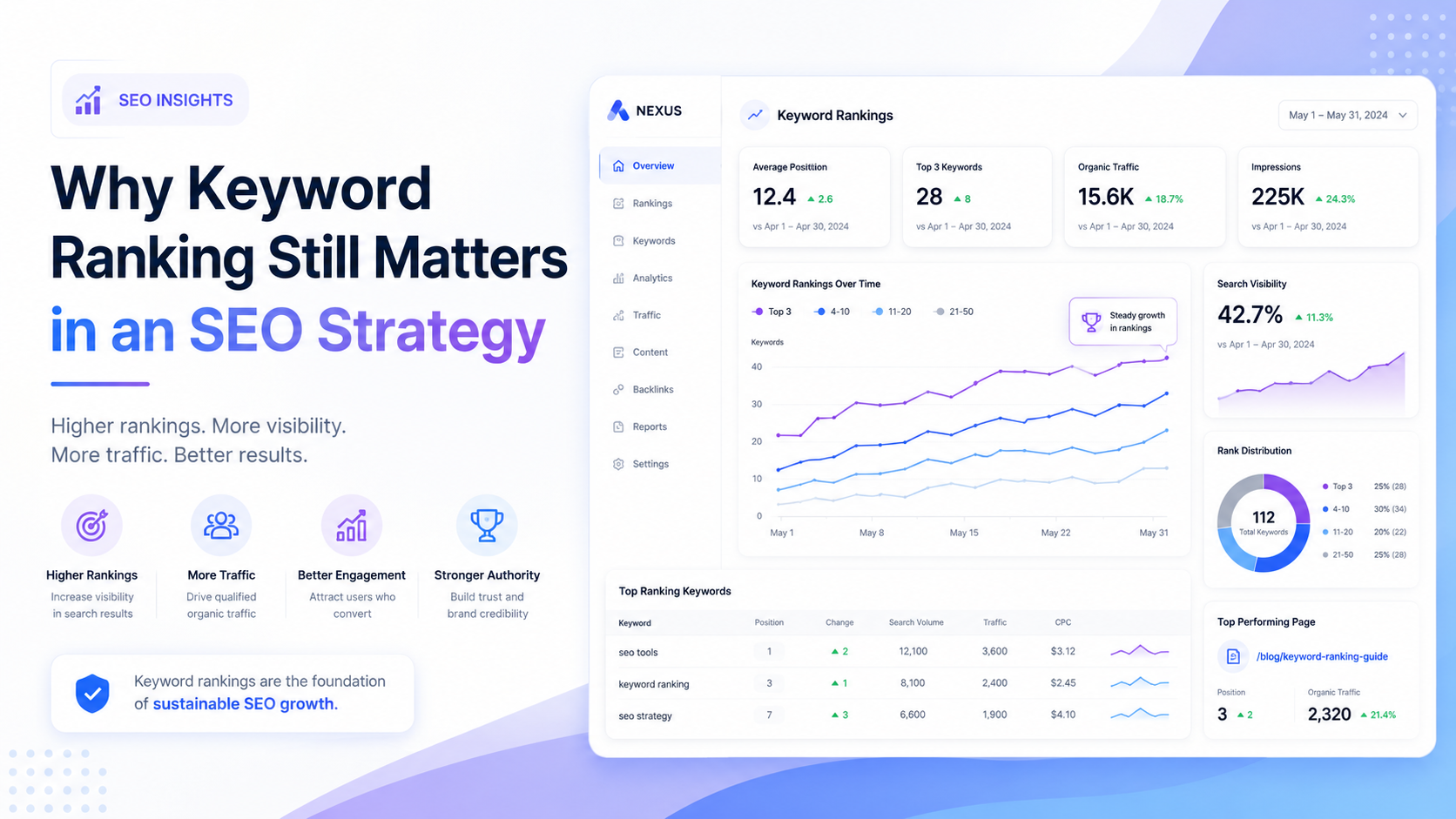
Do keyword rankings still matter for SEO?
Yes, keyword rankings still matter for SEO.
They matter because people still use words and phrases to search. Search engines still use query language and page content to understand relevance. Your page still needs to clearly answer the searcher’s need.
What changed is how search engines interpret keywords.
Modern search is not based on keyword repetition alone. Search engines evaluate relevance, helpfulness, page quality, usability, context, internal links, external signals, and user intent. That means you cannot simply repeat a keyword many times and expect to rank.
But you also cannot ignore keywords.
Keywords help connect three important things:
- What users search for
- What your page is about
- What search engines decide to show
If your content does not clearly align with the words and intent behind a search, ranking becomes harder. So the correct question is not only “Do keywords still matter?” The better question is: how should keyword ranking be used inside a modern SEO strategy?
What keyword ranking actually measures
Keyword ranking measures where your page appears in search results for a specific search query.
For example, if your page appears in position four for “best SEO tips for new websites,” that is your ranking for that keyword. If the same page appears in position twelve for “SEO tips for beginners,” that is another ranking.
This matters because every keyword has its own intent, competition, search result layout, and business value.
A keyword ranking can tell you:
- Whether your page is visible for a target query
- Whether Google understands your page topic
- Whether your content matches search intent
- Whether competitors are outperforming you
- Whether your SEO updates are improving visibility
- Whether a page deserves more internal links
- Whether a page needs a content refresh
But keyword ranking does not automatically tell you whether people are clicking. It does not tell you whether visitors are converting. It does not tell you whether the traffic is valuable. It does not tell you whether the keyword is worth chasing.
That is why ranking should never be measured alone.
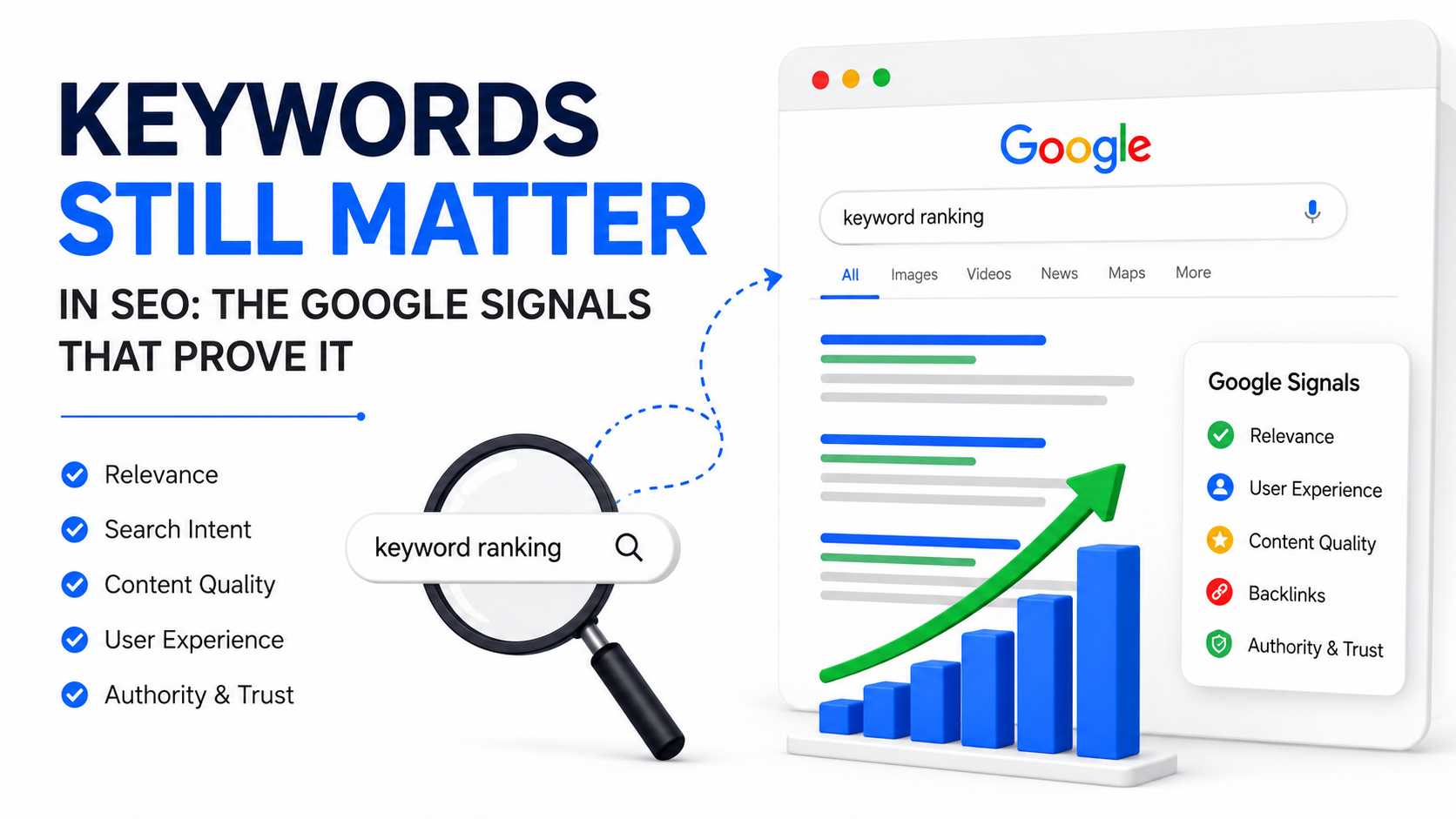
Why keyword ranking still matters in an SEO strategy
Keyword rankings matter because they help turn SEO from guesswork into a measurable system. They are not the only metric, but they help you decide which pages to create, update, connect, and measure.
1. Keyword rankings show search visibility
If your page is not ranking anywhere for your target keyword, it has no meaningful organic visibility for that query.
That does not always mean the page is bad. It may mean the page is new, the keyword is too competitive, the content is too thin, the internal links are weak, or the search intent is wrong.
Ranking data gives you a starting point. A page ranking in positions 8 to 15 for a valuable keyword may be a better optimization target than a page ranking position 60 for a broad vanity keyword.
2. Keyword rankings help you understand search intent
Search intent is the reason behind a search.
A person searching “what is keyword ranking” wants information. A person searching “best keyword rank tracking tool” may be comparing software. A person searching “SEO agency near me” may be ready to buy.
Keyword rankings help reveal whether your page matches that intent. If your blog post ranks for informational keywords but not commercial keywords, your content may be useful for learning but not strong enough for buyer intent.
3. Keyword rankings help prioritize SEO work
Not every page deserves the same effort.
Some pages need a full rewrite. Some need better headings. Some need internal links. Some need stronger meta tags. Some need schema. Some should be left alone because they already perform well.
Keyword ranking data helps you decide what to do next.
4. Keyword rankings improve content planning
Keyword ranking helps you decide what content to create next.
If one article ranks for many related terms, that may show Google sees it as a strong topical page. You can improve it further instead of creating duplicate articles.
If one topic has multiple search intents, you may need separate pages.
5. Keyword rankings guide internal linking
Internal links help search engines understand which pages are important and how topics connect.
If a page is ranking in positions 8 to 15 for a valuable keyword, it may need stronger internal links from related pages.
For example, an article about keyword ranking can internally link to your On-Page SEO Checker, Meta Tags Generator, Schema Markup Checker, and beginner SEO guides.
6. Keyword rankings help measure SEO progress
SEO takes time. Ranking data helps you see whether your efforts are moving in the right direction.
If you update a page and rankings improve after a few weeks, that can show the update helped. If rankings drop, you may need to review the change, competitors, SERP layout, or search intent.
Keyword rankings vs traffic: which matters more?
Traffic matters more than ranking, but ranking often comes before traffic.
A page must usually have visibility before it can earn organic clicks. But a high ranking does not guarantee high traffic. Some keywords have low search volume. Some search results have AI answers, featured snippets, ads, videos, maps, or other elements that reduce clicks.
That is why keyword rankings vs traffic is not an either-or question. You need both.
- Keyword ranking tells you visibility.
- Traffic tells you whether people clicked.
- Conversions tell you whether the traffic had value.
Example
Imagine two pages.
Page A ranks number two for a broad keyword, gets 2,000 visits, and generates zero leads.
Page B ranks number six for a specific long-tail keyword, gets 300 visits, and generates 18 leads.
Page A looks better in a ranking or traffic report. But Page B is more valuable for business.
This is why keyword ranking must be connected to intent and outcomes.
Useful keyword rankings vs vanity keyword rankings
The biggest mistake is treating every ranking improvement as a win. Some rankings matter. Some rankings are noise. Some rankings can even waste your time because they attract the wrong audience.
| Scenario | Useful Keyword Ranking | Vanity Keyword Ranking |
|---|---|---|
| Search intent | Matches the page purpose and user need. | Looks popular but attracts the wrong audience. |
| Business value | Supports leads, sales, signups, or qualified traffic. | Brings visits with no commercial value. |
| SERP layout | Can realistically earn clicks. | Search result is dominated by ads, AI answers, or zero-click results. |
| Page opportunity | Page is close to page one and can improve. | Page ranks low for a broad, unrealistic term. |
| Measurement | Tracked with CTR, traffic, and conversions. | Tracked only as position. |
| Content fit | Page deeply answers the query. | Page mentions the keyword but does not satisfy intent. |
A ranking report should not only say, “We rank number three.” It should answer whether that ranking brings impressions, clicks, qualified visitors, engagement, leads, and revenue.
How AI search changes keyword ranking
AI search does not make keyword ranking useless. It changes how ranking should be interpreted.
Search results now include AI Overviews, featured snippets, People Also Ask boxes, videos, product results, local packs, and other SERP features. In some cases, users get answers without clicking any website.
This means ranking position alone is less complete than before.
You may rank well but get fewer clicks because the search result answers the question directly. You may also gain visibility if your content is cited, summarized, or used as a trusted source in AI-powered search experiences.
The goal is not only to rank. The goal is to become a useful, trusted source for the topic.
How to build a modern keyword ranking workflow
A modern keyword strategy should use rankings as one signal inside a larger workflow.
Step 1: Start with search intent
Before writing content, identify what the searcher wants. Are they learning, comparing, buying, looking for a tool, or solving a specific problem?
Your page type should match the intent. “What is keyword ranking?” needs an educational article. “Best keyword rank tracking tool” may need a comparison page. “Why keyword ranking still matters in an SEO strategy” needs a strategic guide.
Step 2: Choose one primary keyword theme
One page should have one primary keyword theme. That does not mean the page can rank for only one keyword. A strong page can rank for many related terms, but it should have one clear purpose.
Step 3: Build a strong page structure
A strong SEO article should be easy for users and search engines to understand. Use one clear H1, descriptive H2 sections, helpful H3 subsections, short paragraphs, examples, tables, internal links, FAQs, and a clear conclusion.
Step 4: Optimize on-page SEO
Keyword ranking depends partly on how clearly your page communicates the topic. Optimize the SEO title, meta description, URL slug, H1, intro, H2 headings, internal links, image alt text, schema, and content depth.
Use your On-Page SEO Checker to review title, headings, content structure, links, and common page issues.
Step 5: Improve the snippet
A ranking without clicks is weak. Write a useful title tag and meta description that match intent and create a reason to click.
Your Meta Tags Generator can help create clean title, description, Open Graph, and Twitter card tags.
Step 6: Strengthen internal links
Link from related pages using natural anchor text. For this topic, related internal links could include What Is SEO for Beginners, Top SEO Tips for New Websites, and your SEO tool pages.
Step 7: Track rankings with CTR and conversions
Review rankings together with impressions, CTR, clicks, engagement, and conversions. A ranking increase that brings no qualified traffic may not be worth celebrating. A smaller ranking improvement on a high-intent keyword can be far more valuable.
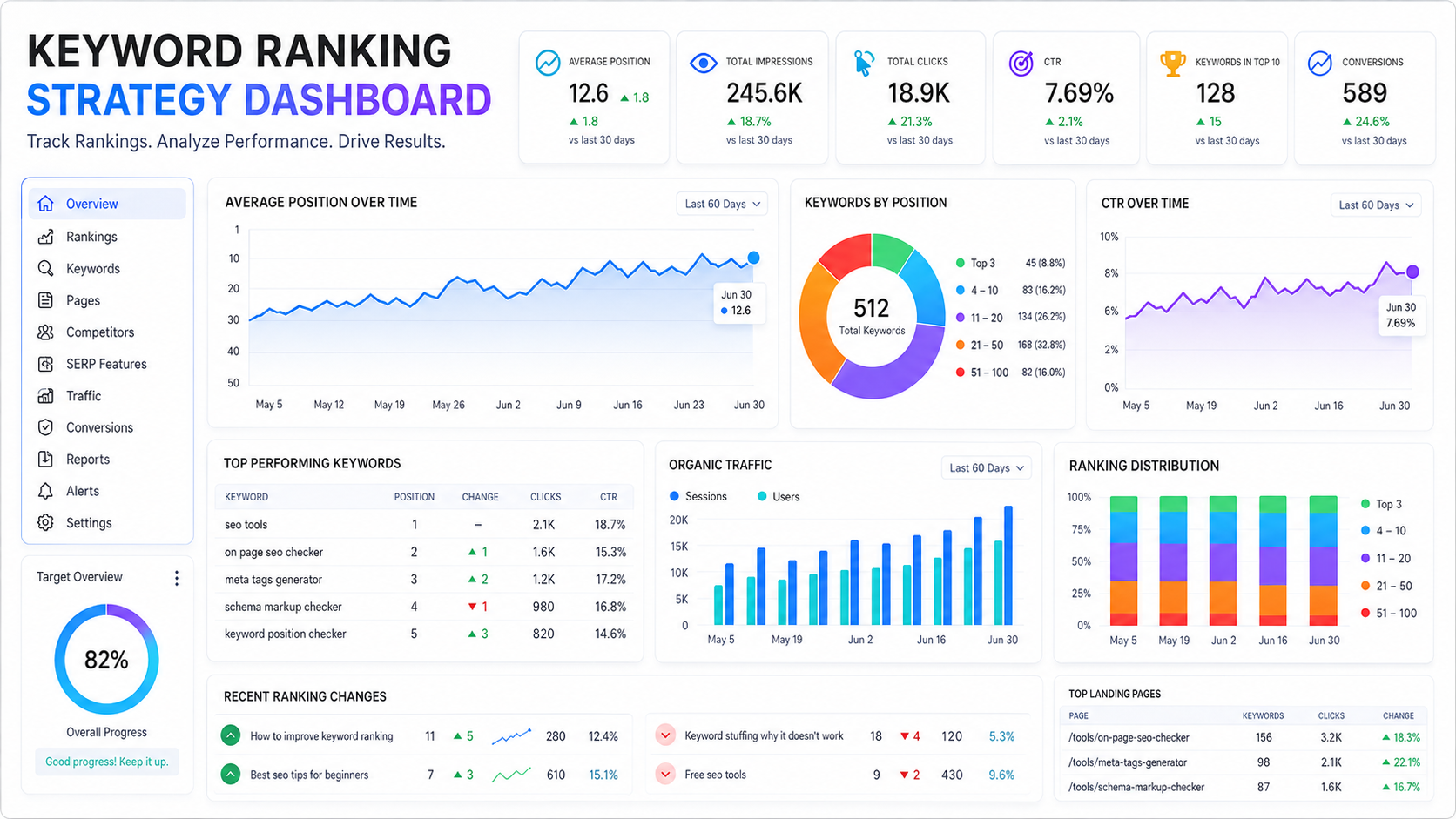
Check your page before tracking rankings
Review your title, headings, internal links, meta tags, and structure before judging ranking performance.
Important metrics to track alongside keyword ranking
Keyword rankings are useful, but they need context. Track the full path from visibility to value.
- Impressions: Shows how often your page appears in search results.
- CTR: Shows whether users click your result.
- Organic clicks: Shows actual traffic from search.
- Qualified traffic: Shows whether visitors match your target audience.
- Engagement: Shows whether users stay, scroll, click, or leave quickly.
- Conversions: Shows whether SEO traffic creates value.
- Revenue: Shows whether organic search contributes to business growth.
- SERP features: Shows whether AI answers, snippets, videos, ads, or maps affect clicks.
Common keyword ranking mistakes
Mistake 1: Tracking too many keywords
Tracking hundreds of keywords can create noise. Focus on keywords that matter to your pages, audience, and business goals.
Mistake 2: Ignoring search intent
A page can rank for a keyword and still fail if the intent is wrong. Always check what users expect from the search result.
Mistake 3: Chasing only high-volume keywords
High-volume keywords are often broad and competitive. Long-tail keywords may bring fewer visits but better conversions.
Mistake 4: Measuring rankings without CTR
A ranking is incomplete without click data. If users do not click, the ranking has limited value.
Mistake 5: Forgetting internal links
Internal links help search engines understand page importance. Many pages fail because they are published and then left isolated.
Mistake 6: Using keyword stuffing
Repeating the same phrase too many times makes content worse. It does not create helpfulness, authority, or trust.
Mistake 7: Ignoring SERP features
AI Overviews, ads, snippets, videos, and People Also Ask boxes can change how much traffic a ranking generates.
Are keywords still important if Google understands topics?
Yes, keywords are still important because topics are built from language.
Google may understand topics better than before, but users still search with words. Your content still needs to reflect the language your audience uses.
The difference is that modern SEO is not about exact-match repetition. It is about covering the topic clearly.
For example, a page about keyword ranking should naturally discuss search intent, keyword research, ranking position, organic traffic, CTR, conversions, content optimization, internal linking, SERP features, and vanity metrics.
How many keywords should one page target?
One page should target one main intent.
It can include one primary keyword and several related keywords, but they should all support the same search purpose.
For example, this article targets the primary keyword “why keyword ranking still matters in an SEO strategy” and supports related phrases like “keyword ranking still relevant,” “do keywords still matter for SEO,” “keyword rankings vs traffic,” “search intent and keyword ranking,” and “vanity metrics SEO.”
These belong together because they answer the same broader question. But if you want to target “best rank tracking tools,” that may need a separate comparison article or tool page because the intent is different.
How SEOParents tools fit into this strategy
Keyword ranking becomes more useful when your page is technically clean and properly optimized. Before tracking rankings, make sure the page gives search engines and users the right signals.
Use the On-Page SEO Checker to review page structure. Use the Meta Tags Generator to create better title and description tags. Use the Schema Markup Checker to validate structured data. Use the Robots.txt Generator to avoid crawl-control mistakes.
These tools do not replace strategy. They support it. The strategy is still simple: match the right keyword intent, create the right page, optimize it clearly, connect it with internal links, and measure rankings against business outcomes.
FAQs about keyword ranking in SEO
Do keywords still matter for SEO?
Yes. Keywords still matter because they help connect user searches with relevant content. They should be used naturally in titles, headings, body content, links, and image alt text.
Is keyword ranking still relevant?
Yes. Keyword ranking is still relevant because it shows search visibility. But it should be measured with CTR, traffic quality, and conversions.
Are keyword rankings vanity metrics?
Keyword rankings become vanity metrics when they are tracked without business value, search intent, CTR, or conversions.
What is more important: keyword ranking or traffic?
Traffic is more important than ranking, but ranking helps create visibility. The best approach is to measure ranking, CTR, qualified traffic, and conversions together.
Should I track every keyword?
No. Track keywords that matter to your pages, audience, and business goals. Too many tracked keywords can create noise.
Is keyword density still important?
No. Keyword density is not a reliable SEO strategy. Natural keyword use, helpful content, search intent, and page quality matter more.
Does the meta keywords tag help SEO?
No. The meta keywords tag is outdated and does not help modern Google rankings.
How many keywords should one page target?
One page should target one primary intent and one main keyword theme. It can also rank for many related keywords if the content is complete and useful.
Conclusion: keyword ranking still matters, but only with context
Keyword ranking still matters in an SEO strategy because it shows whether your page is visible for the searches that matter.
But ranking is not the final goal.
A keyword ranking is useful only when it connects to search intent, CTR, qualified traffic, conversions, and business value. Ranking number one for the wrong keyword does not help. Ranking number five for a keyword that brings leads may be a major win.
Modern SEO is not about stuffing keywords or chasing vanity positions. It is about understanding what people search for, creating the best page for that intent, optimizing it clearly, and measuring whether it produces real results.
So yes, keyword ranking still matters. It matters as a signal. It matters as a planning tool. It matters as a visibility metric. It matters as part of a larger SEO strategy.
But it should never stand alone.
The strongest SEO strategies use keyword rankings to make smarter decisions, not to create prettier reports.
Build stronger SEO pages
Use SEOParents tools to improve on-page SEO, generate better meta tags, and validate schema before tracking rankings.